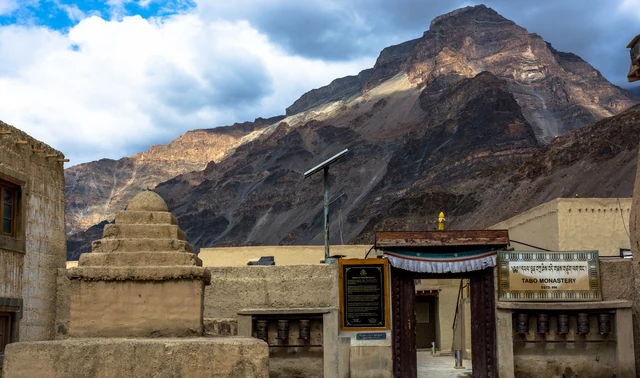
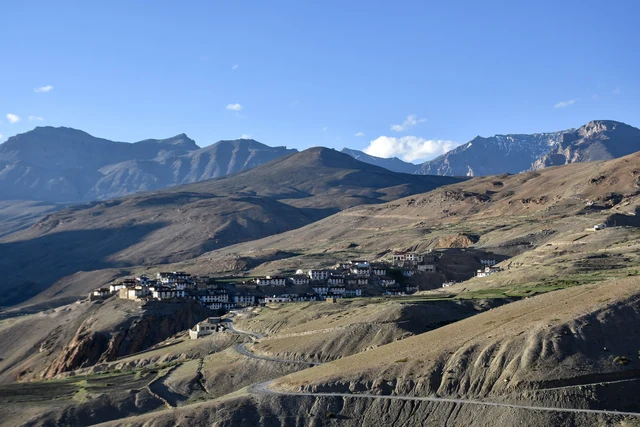
Kunzum Pass (Kunzum La) — the gate between Lahaul and Spiti, and when it is open
Kunzum La, 4,551 m, joins Lahaul and Spiti: 122 km from Manali, 79 km from Kaza, open roughly June to October, with the Chandratal trek from the top.
Checked on
In the forest of northern Tripura there is a place whose name is a number. Unakoti means one less than a crore. Una is one less and koti is a crore, and the number is the whole story of the hill.
Shiva Ji was on his way to Kashi, and a crore of gods and goddesses went with him, counting himself. They stopped here for the night. There was one condition: everyone was to be up before sunrise, to go on.
Morning came, and Shiva Ji alone was awake. The others slept on. He went on to Kashi by himself, and his curse turned them all to stone where they lay. That is why the hill holds one less than a crore, and why it is still a holy place of Shiva.
Nobody has counted ten million carvings here, and no one claims to have. The number belongs to the story.
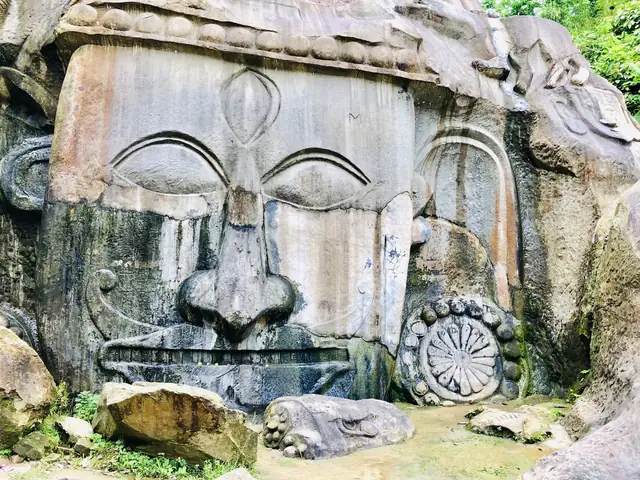
The carvings on the hill are of two kinds, great figures cut into the rock faces and smaller stone images. The one people come for is the central Shiva head, Unakotiswara Kal Bhairava. The Ministry of Tourism gives it about 30 feet, and 10 feet of that is its headdress. UNESCO's entry adds the detail: a third eye set upright on the forehead, eyes with no pupils, a long straight nose, and teeth marked as a row of lines in a slit of a mouth.
It is not the only great head on this hill. There are several, and captions online often mix them up. One shows Shiva with his locks falling like rope on either side. Further down the stream a panel holds three huge Ganesha figures, and UNESCO gives the seated one 22 feet.
Photos: Barunghosh (CC BY-SA 4.0) · Sanjibroy56 (CC BY-SA 4.0) · Proper Chopper (CC BY-SA 4.0) · Vulpes-bengalensis (CC BY-SA 4.0) · Vulpes-bengalensis (CC BY-SA 4.0) — via Wikimedia Commons, resized.
Nobody signed these rocks. UNESCO's entry dates the reliefs to the 8th and 9th centuries on grounds of style. Wikipedia widens that to the 7th to 9th, and the Ministry of Tourism says the 7th century or even earlier. We found no source that gives a founding date, and UNESCO can only suggest who may have paid for the work.
The site is on UNESCO's tentative list, added in December 2022. That is a step before inscription, so it is not a World Heritage Site. Rain and earthquakes have worn the figures, UNESCO notes, and the Archaeological Survey of India looks after them.
The big gathering is the Ashokastami Mela, held in April by the Ministry of Tourism's account, and in the month of Chaitra by UNESCO's. Thousands of pilgrims come for it, and the pools at the foot of the hill are part of the fair.
Unakoti lies about 8 km from Kailashahar. From Agartala, Wikipedia says 178 km and UNESCO says 185 km. The airport is at Agartala. For the railway, the Ministry of Tourism names Kumarghat and Wikipedia names Dharmanagar, so check which suits your train.
For more of India's stories, read about Rani ki Vav, the stepwell on your ₹100 note, the floating park on Loktak Lake in Manipur, or how the British learned polo from Manipur. For more of the Northeast, start with Shillong and Kohima.
Reels from these places: follow @himlocal.in on Instagram
It means one less than a crore. Una is one less and koti is a crore in Bengali, and a crore is ten million. In the Kokborok language the place is called Subrai Khung. The name comes from the legend of the sleeping gods, and it is not a count of the carvings.
The sources do not agree exactly. UNESCO's tentative-list entry ascribes the reliefs to the 8th to 9th century on grounds of style, Wikipedia says 7th to 9th, and the Ministry of Tourism says the 7th century or even earlier. So the carvings are over a thousand years old, and we found no founding date.
About 30 feet. That is the central head, Unakotiswara Kal Bhairava, and the height counts a headdress of 10 feet by the Ministry of Tourism's account. UNESCO gives the same 30 feet. Several great Shiva heads stand on this hill, so make sure you are looking at the right one.
No. It has been on India's tentative list since December 2022, which means it has been put forward for consideration. It has not been inscribed on the World Heritage List. The entry is called the Rock-cut Sculptures and Reliefs of the Unakoti, and the site is in the care of the Archaeological Survey of India.