Rani ki Vav — the stepwell on your ₹100 note that lay buried in silt
Rani ki Vav at Patan, Gujarat: a queen's 11th-century stepwell, buried by the Saraswati's silt, dug out in the 1940s, on the ₹100 note since 2018.
Checked on
Turn over a lavender ₹100 note and you are looking at a building you walk down into. The Queen's Stepwell, Rani ki Vav, stands in Patan, Gujarat. For a long stretch of its life almost nothing of it showed above the ground.
Credit for it goes to Udayamati, wife of the Chaulukya king Bhima I. The chronicle Prabandha-Chintamani, written by the Jain monk Merutunga in 1304, says she built this new stepwell at the city it calls Shripattana. That text has it begun in 1063 and finished twenty years on. The historian Commissariat reads the style differently, compares it with the Vimalavasahi temple at Mount Abu and argues for 1032. The sources do not agree, so this page gives the 11th century and stops there.
Why she built it is less settled than you may have heard. UNESCO calls the well a memorial to a king. Wikipedia says only that this is generally assumed, and that scholars dispute whether Udayamati was already a widow when she ordered it.
An upside-down temple
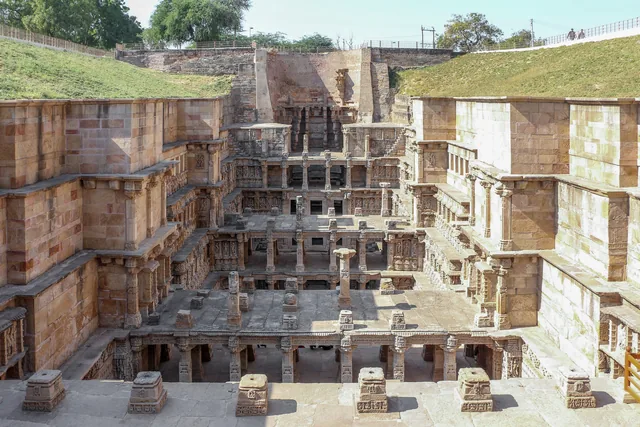
A stepwell brings you down to water that lies far below a dry plain. This one was laid out as a temple turned on its head, to honour the water itself. There are seven levels of stairs, running east to west. Near the bottom, the fourth level opens on a rectangular tank, 23 m down, nearly square, with sides of 9.5 m and 9.4 m. The well itself lies at the far western end, a shaft 10 m across and 30 m deep.
The walls are what people come for. UNESCO counts over a thousand minor sculptures and more than 500 main ones. Vishnu's incarnations stand among goddesses, and between them are women going about the small business of a day.
The Saraswati ran beside the well. UNESCO puts a change in the river bed in the 13th century, with a flood that left the structure full of silt. It stopped being a well. UNESCO credits that same silt with preserving the stepwell so well.
By the 1890s the place had nearly gone. Henry Cousens and James Burgess came to see it and found a great pit with the well shaft and a few pillars showing. James Tod had noted that stone from it was carried off for another stepwell in the newer town.
Dug out, and listed
Excavations under Baroda State in the 1940s uncovered the stepwell again. The Archaeological Survey of India then restored it between 1981 and 1987, and an image of Udayamati turned up during the work. UNESCO added it to the World Heritage List on 22 June 2014.
The Reserve Bank of India announced the new ₹100 note on 19 July 2018 and named the stepwell as the motif on its reverse, as a sign of the country's heritage. Older ₹100 notes stayed legal tender, so check which one you are holding.
Been here?Help the next traveller — our team checks every contribution.
Questions people ask
Which monument is on the ₹100 note?
Rani ki Vav, the stepwell at Patan in Gujarat that is also called the Queen's Stepwell. The Reserve Bank of India announced the lavender ₹100 note of the Mahatma Gandhi (New) Series on 19 July 2018, with a motif of the stepwell on the reverse. Older ₹100 notes stayed legal tender, so not every note carries it.
Who built Rani ki Vav and when?
Its construction is credited to Queen Udayamati, wife of the Chaulukya king Bhima I, in the 11th century. The sources differ on the year. The Jain chronicle Prabandha-Chintamani says it was commissioned in 1063, and the historian Commissariat argues for 1032, so this page gives only the century.
Why was Rani ki Vav buried?
The Saraswati flooded it and filled it with silt. UNESCO ties this to a change in the river bed in the 13th century, and says the same silt is what kept the carving so well. By the 1890s visitors could make out only the shaft and a few pillars.
How many sculptures are there in Rani ki Vav?
UNESCO counts over a thousand minor sculptures and more than 500 main ones, set on seven levels of stairs. They mix religious, mythological and everyday subjects, and many of them draw on literary works. Treat the figures as UNESCO's own count of a very large body of carving, because we have not found a published list of the panels.