
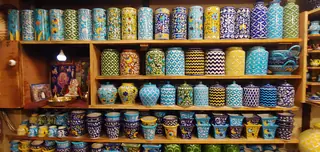
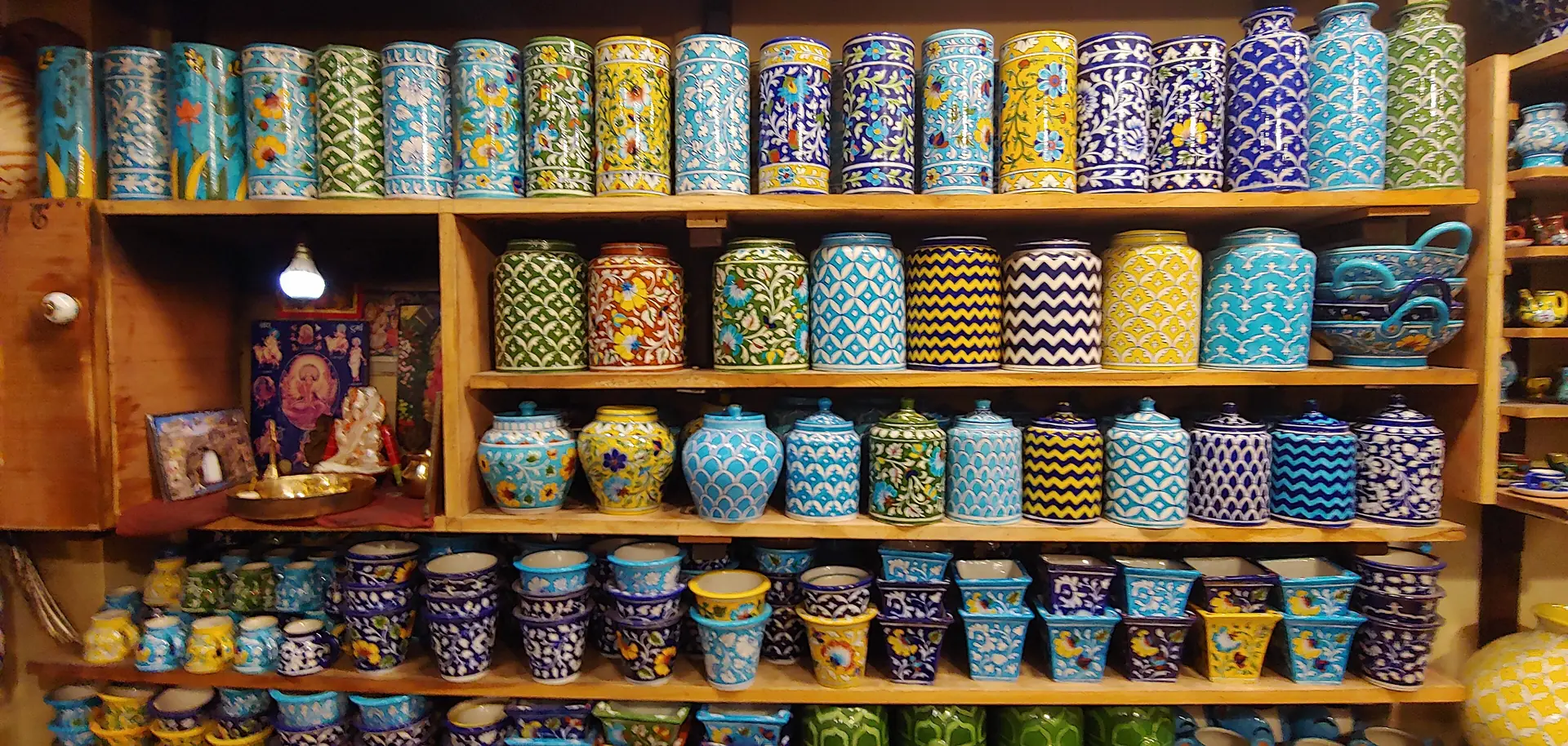
Jaipur blue pottery — the pottery made without potter's clay
Jaipur blue pottery looks like any glazed earthenware until you learn what is inside it. There is no potter's clay. The body is ground stone and glass held together with earth and gum, it goes into the kiln only once, and it comes out at a heat far lower than ordinary pottery needs. Those two facts explain both its colour and its fragility.
Photos: Neek-Theri (CC BY-SA 4.0) — via Wikimedia Commons, resized.
Stone, glass, earth and gum
The "dough" starts as ground quartz and powdered glass. Multani mitti, a fuller's earth sold in bazaars across the country, binds them, with borax and gum added and water to knead it all. One account adds katira gond, another gum, and saaji. Multani mitti is an earth, so it is fair to say the craft uses no clay only in the potter's sense: nothing here is thrown on a wheel from a lump of wet clay. The result is closer to a frit, the glassy ceramic body of Egyptian faience, than to a terracotta pot.
The palette is just as narrow. Blue comes from cobalt oxide, green from copper oxide, and the rest is white; yellow and brown appear now and then, but the blue is what gives the craft its name. Designs lean on nature, animals, birds and flowers, with Persian geometry and Mughal arabesques in the borders.
Made in a mould, fired once
Because the dough cannot be thrown, it is rolled out like a chapati, a few millimetres thick, and pressed into a Plaster of Paris mould packed with a mix of pebbles and ash. Turned out after a day or two of drying, the piece is cleaned, shaped and sanded smooth, then painted by brush and glazed. Traditionally the artisans prayed before they lit the furnace, and some still do. The firing takes four to five hours with the heat kept even, because an uneven kiln cracks the work, and the pieces stay inside until the kiln has cooled completely, which can take two or three days.
That single, gentle firing is the craft's weakness as well as its method. The low heat suits a body of quartz and glass, but it leaves the finished piece more fragile than glazed earthenware. Most blue pottery is therefore decorative or for light use: plates, vases, surahis, bowls, coasters, tiles, door knobs and small boxes.
How it reached Jaipur
The cobalt-blue tradition is old and it travelled a long way. Blue-and-white wares began in Iraq under the Abbasids, the use of cobalt passed to China, and Mongol craftsmen joined Chinese glazing to Persian decoration. The technique reached India with the Turkic conquests of the 14th century, first as tiles for mosques, tombs and palaces, then through the Mughals to the potters of Delhi, and from there, in the 17th century, to Jaipur.
Another account puts its arrival in the 19th century, under Sawai Ram Singh II, who ruled Jaipur from 1835 to 1880 and is said to have sent local artisans to Delhi to learn it. The fountains of the Rambagh Palace, lined with blue tiles, are among the older work that survives. By 1916 a journal of Indian art was calling Jaipur's ware an improvement on Delhi's.
Gone by the 1950s, then brought back
By the 1950s the craft had almost died out in Jaipur. It came back through the muralist and painter Kripal Singh Shekhawat, who made its revival his work, with patrons including Kamaladevi Chattopadhyay and Rajmata Gayatri Devi behind him. His studio, Kripal Kumbh, is still working. Today the craft supports many families in Jaipur and in nearby Sanganer, Mahalan and Neota. It has also changed with its market: lead-free glazes instead of lead, diesel furnaces in many workshops in place of wood or charcoal, and new shapes alongside the classic motifs.
Jaipur blue pottery on HimLocal
The Banjara, a shop on HimLocal, lists hand-painted Jaipur blue pottery made by artisans in Rajasthan: the lotus wall plate from the reel, a geometric wall plate, a royal indigo vase, a surahi vase, a floral canister and a cake stand. Prices and stock are on each listing.
More stories from across India
From the same series: phulkari, Punjab's embroidery worked from the back, Loktak and the national park that floats, and the butter-joined Shivling of Bijli Mahadev above Kullu. In the hills, the Kullu shawl is the valley's woven craft, and the Kullu guide is where to start. All the HimLocal guides are under Destinations, and every story is on the Blog.
Questions people ask
What is Jaipur blue pottery made of, if not clay?
Ground quartz and powdered glass, bound with multani mitti, a fuller's earth, plus borax and gum, kneaded with water. One account adds katira gond, a gum, and saaji. Multani mitti is an earth, but not the potter's clay a wheel thrower uses, which is why the craft is described as using no clay.
Why is Jaipur blue pottery fragile?
It is fired only once, and at a very low temperature, which is what the quartz-and-glass body needs. That low firing is also why it chips more easily than ordinary glazed earthenware. Most pieces are made for display or light use: plates, vases, bowls, coasters, tiles and small boxes.
Who revived Jaipur blue pottery?
By the 1950s the craft had nearly vanished from Jaipur. The muralist and painter Kripal Singh Shekhawat brought it back, supported by patrons including Kamaladevi Chattopadhyay and Rajmata Gayatri Devi. His studio, Kripal Kumbh, still works, and the craft now supports many families in Jaipur and nearby towns.