
Phulkari — the Punjab embroidery that is worked from the back
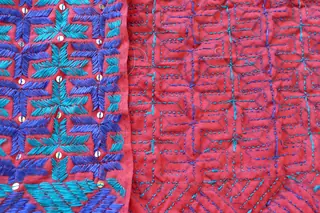
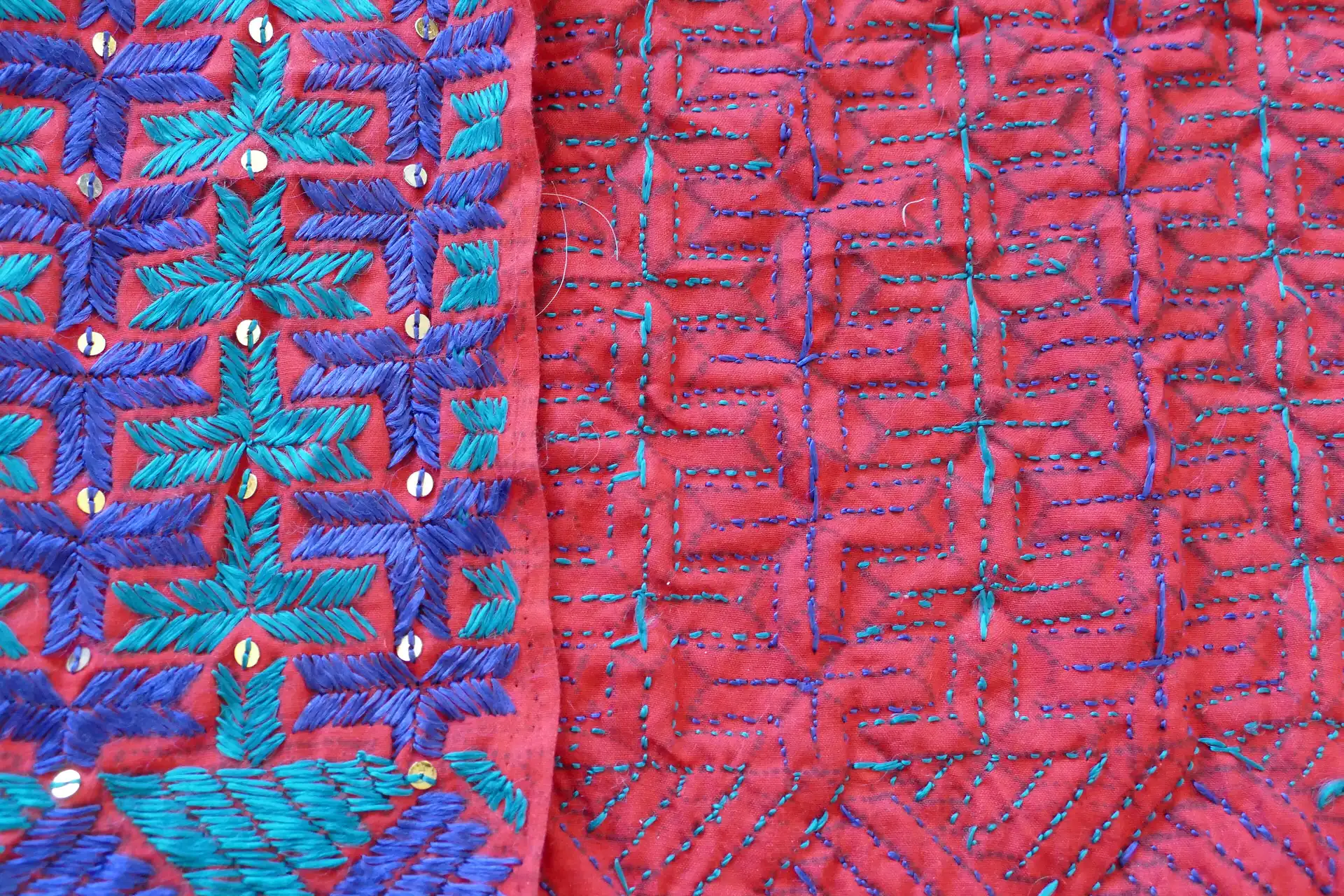
Phulkari means "flower work". It is the folk embroidery of Punjab, done for centuries by women at home, and its strangest fact is the one in the picture above: it is stitched from the back of the cloth. You wear one face; the needle lives on the other.
Photos: Kritzolina (CC BY-SA 4.0) · Kritzolina (CC BY-SA 4.0) · Sheebamadanloewinger (CC BY-SA 4.0) · Chiswick Chap (CC BY-SA 4.0) · Chiswick Chap (CC BY-SA 4.0) · Madreiling (CC0) · Hiart (CC0) — via Wikimedia Commons, resized.
Stitched from the reverse, counted, never traced
The traditional base is khaddar, a coarse cotton spun on the charkha at home, dyed and then woven in narrow widths and joined. Its coarseness is the point. The embroiderer works a darn stitch from the wrong side, counting the threads of the weave as she goes, so the long runs of silk land on the face and only short stitches remain behind. Nothing was drawn on the cloth first: there were no stencils, no pattern books and no tracing, and the designs moved between households by word of mouth.
The thread is patt, a soft untwisted silk floss, brought from Kashmir, Afghanistan and Bengal and dyed in the cities. Red and its shades were the favourite colour, because red is auspicious for both Hindus and Sikhs in Punjab. The motifs are flowers, but also wheat and barley ears, birds, animals and, in the sainchi style of the south-west, whole scenes of village life. Sainchi is the one style where outlines were drawn in ink first; every other kind was counted.
A line from the seventh century
How old is it? Nobody can give a year. The Harshacharita, the life of the emperor Harshavardhana written by his court poet Bana (Banabhatta), describes people working flowers and leaves into cloth from its reverse side, which is as close to a description of phulkari as an early text gets. That puts the idea about 1,400 years back. The word phulkari itself first appears much later, in Waris Shah's 18th-century Heer Ranjha, among the bride's trousseau, and the form we recognise is usually dated from the 15th century. Its origin is argued over: one view keeps it in India, another links it to the Persian gulkari, "flower work" too.
Begun on the day a daughter was born
It is said that when a girl was born, her mother and grandmothers began embroidering phulkaris and baghs for her, to be given at her wedding. A bride's family might give anywhere from 11 to 101 pieces, and the best were kept as heirlooms. Women worked together, in a courtyard swept for the occasion, and sang while they stitched. One song, still quoted, runs "Ih Phulkari Meri Maan Ne Kadhi": my mother embroidered this phulkari, and I hold it close. The pieces were made for the family, not for sale.
Phulkari or bagh
The two words name the density, not a different stitch. A phulkari, in the narrow sense, has its flowers scattered and the plain cloth showing between them. A bagh, "garden", covers the base almost entirely, worked in horizontal, vertical and diagonal runs; the old baghs took their names from what the women saw around them, from the rolling pin to the cauliflower to the layout of Mughal gardens. Today the everyday dupatta or shawl is called a phulkari and the heavy wedding piece a bagh. Other named kinds include the chope, embroidered so that it reads on both faces, and the chhamaas, with small mirrors sewn in.
What happened to it
By the 1950s the old way of making phulkari had faded across Punjab. Work picked up again after Partition, when organisations helped refugee women embroider for a living, and in 2011 phulkari received Geographical Indication status for registered makers in Punjab, Haryana and Rajasthan. The difficulty now is the machine: cheaper factory-made "phulkaris" on synthetic cloth sit beside hand-embroidered ones, even in craft markets, and most embroiderers today work over a printed guide rather than counting threads. The handloom expert Jasleen Dhamija has said the form nearly died because nobody promoted it.
Hand-embroidered phulkari on HimLocal
The Banjara, a shop on HimLocal, lists hand-embroidered phulkari dupattas from Punjab in silk floss: an authentic handmade dupatta, a floral one, a geometric one, and two with mirror work, designer and premium. Prices and stock are on each listing.
More stories from across India
The same reels told the story of Jaipur's blue pottery, made without potter's clay, of Loktak and the national park that floats, and of the Shivling joined with butter at Bijli Mahadev. Closer to the hills, the Kullu shawl is the valley's own woven craft, and the Kullu guide is where to start a trip there. Every HimLocal guide is under Destinations, and every story under the Blog.
Questions people ask
Why is phulkari embroidered from the back?
The traditional method works a darn stitch from the reverse of coarse hand-woven cotton, counting the threads of the weave instead of following a drawn line. The long runs of silk show on the face and only short stitches show behind. No pattern books existed; designs passed from mother to daughter by word of mouth.
What is the difference between a phulkari and a bagh?
Strictly, a phulkari carries scattered flowers with the plain base cloth still showing between them. A bagh, meaning garden, is worked so densely that the embroidery covers almost the whole cloth. Today everyday dupattas and shawls are usually called phulkaris, and the heavy wedding pieces baghs.
How old is phulkari embroidery?
Nobody knows its exact start. A seventh-century court biography of Harshavardhana describes people stitching flowers and leaves into cloth from its back, which reads like phulkari. The word itself first appears in Waris Shah's Heer Ranjha in the 18th century. The form as we know it is usually dated from the 15th century.