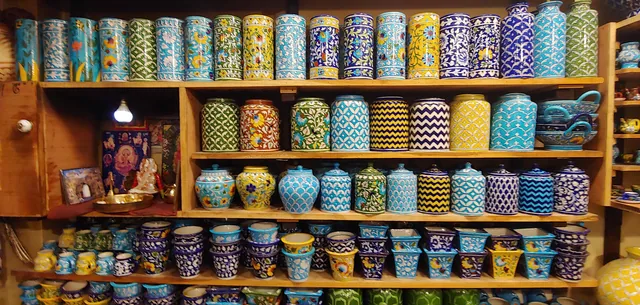
Jaipur blue pottery — the pottery made without potter's clay
Jaipur blue pottery uses no potter's clay: quartz, glass, multani mitti and gum, fired once at low heat. How it is made, how it nearly vanished, who saved it.
Checked on
September is clear and cooler. Our weather page gives Leh a day of 23.4 °C and a night of 9.2 °C. The Ladakh Festival brings polo, archery and monastic dances, and the crowds of August thin out.
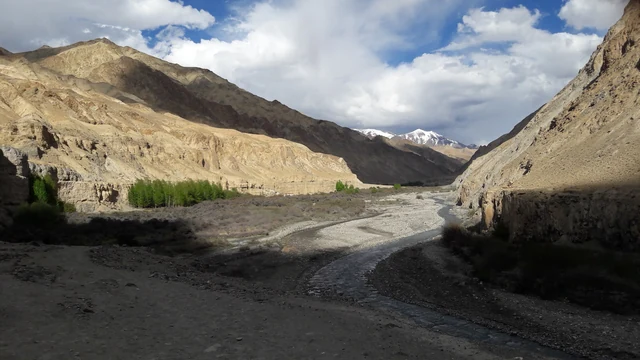
Markha Valley is Ladakh's best-known trek: up the Markha river through Hemis National Park, sleeping at Skiu, Markha and Hankar, to the high pasture of Nimaling under Kang Yatse, then over the Kongmaru La down to Shang Sumdo. Nights are in village homestays or camps. The highest point of the route on our map is 5,264 m.
Who it suits: Experienced trekkers. Go with a guide or an outfit. How long: Most of a week. A jeep road now climbs the valley from Chilling past Markha, so the first days share it.
In September: The settled weeks of the season, with Leh still warm and dry.
Getting there: By road from Leh down the Indus past the Zanskar–Indus confluence to Chilling. You come out at Shang Sumdo, near Hemis. Our map marks a permit for the national park; ask in Leh.
Read on: the route on our map.
Stok La from Zingchen is the crossing from Zingchen in Hemis National Park up the Rumbak valley and over the Stok La to Stok village, across the Indus from Leh. Rumbak's homestays break the climb. The highest point of the route on our map is 4,866 m.
Who it suits: Experienced trekkers. Go with a guide or an outfit. How long: Two days, with a night at Rumbak.
In September: Inside Ladakh's dry season, with the pass clear.
Getting there: By road from Leh past Spituk to Zingchen. You come down at Stok, below Stok Palace. Our map marks a permit for the national park.
Read on: the route on our map.
Sham Valley is the low village walk west of Leh from Likir through Yangthang and Hemis Shukpachan to Temisgam, over a string of small passes, sleeping in village homes each night. Low for Ladakh, but steep up and down. The highest point of the route on our map is 3,974 m.
Who it suits: First-timers who already walk for a few hours at a stretch. How long: Two or three days, by Wikivoyage. Parts now follow the village road.
In September: Harvest time in the fields, with clear, settled days.
Getting there: By road or the daily buses from Leh to Likir, below Likir Monastery. Our western monasteries day passes the start.
Read on: the route on our map; our plan: Phyang, Basgo and Likir in a day.
Lamayuru to Chilling is the hard crossing from Lamayuru, one of Ladakh's oldest monasteries, over a run of high passes and through the villages of Wanla and Hinju to Chilling on the Zanskar. A road now reaches Hinju, so one day is on it. The highest point of the route on our map is 4,889 m.
Who it suits: Experienced trekkers. Go with a guide or an outfit. How long: Most of a week, camping or in village homes.
In September: Inside Ladakh's dry season, with both highways to Leh open.
Getting there: By road from Leh along the Srinagar highway to Lamayuru; buses run from Leh. You come out at Chilling, a drive back to Leh past the Zanskar–Indus confluence.
Read on: the route on our map.
These are not treks on our map. They are walks that our own pages and the open guides give for this month.
Day hikes from Leh. Wikivoyage lists short hikes from the town itself: Chhamkang Ri, a hike of about two hours on the north side of Leh with a view over the valley, and a full day from Phyang back to Leh over the Gyamche La. Good first days while you get used to the height. Inside the June to September season our Leh page gives, when the roads are open and the days warm. Read on: best time to visit Leh; Shanti Stupa; our plan: Leh in three days, a first trip.
Closed on our map in September, so not listed above. Each line gives the months it is open.
A trek appears on a month's page only if its season on our map covers that month. Inside that season it is marked best where the map's own note and the open sources agree, and otherwise it goes under «with a catch» with the reason. Ladakh is a cold desert, so its trek season is set by snow on the passes and by the roads, not by the monsoon. A walk or a plan is listed only in the months our page or plan gives for it. We grade nothing beyond what the map records, and this page gives no prices.
August comes before and October after. The Ladakh trek calendar has every month on one page. For Leh itself, see the best time to visit Leh, and for the weather across the region the best time to visit Kashmir and Ladakh.
September elsewhere: treks in September in Kashmir, treks in September in Himachal and treks in September in Uttarakhand.
Reels from these places: follow @himlocal.in on Instagram
September is the last full month of the Ladakh season. On our map Markha Valley, Stok La, Lamayuru to Chilling and Sham Valley are all at their best, with clear, settled days and colder nights. The Ladakh Festival is held in Leh this month. The high treks close after September.
Yes. On our map September is inside Markha Valley's best weeks: the snowmelt has dropped, the days are clear, and the busiest weeks are over. Nights at Nimaling are cold, so carry warm layers. It is the last month on our map before the high treks close.
A festival held in Leh in September, by our weather page, with polo, archery and monastic dances. It falls in a good trek month, so it fits before or after a walk such as Markha Valley or Sham Valley. Check the year's dates with the district before you plan around it.