
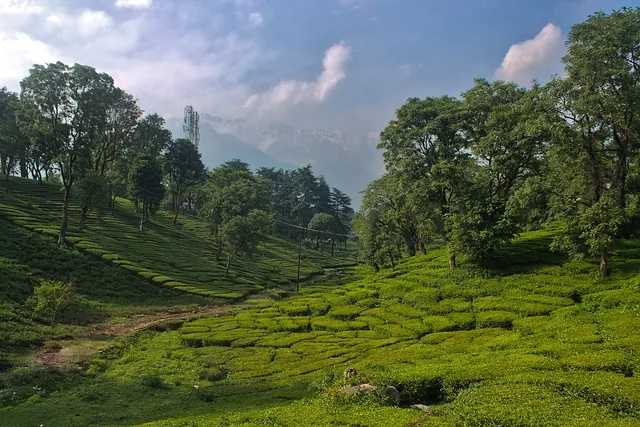
Palampur tea gardens
Checked on
What it is
The terraced tea estates at the edge of Palampur, with the Dhauladhar range behind them. The tea bush flourished in the local climate, and mostly European estate owners expanded the gardens from the mid-19th century. That growth brought schools, colleges and hospitals to the town.
Photos: UnpetitproleX (CC BY-SA 4.0) — via Wikimedia Commons, resized.
A short history of Kangra tea
A survey in 1848 judged the Kangra hills suitable for tea, and a Chinese variety of the bush was planted across the region. It did well at Palampur and Dharamshala and failed in most other places. By the 1880s the leaf was rated above tea from other districts and was being bought in Kabul and across Central Asia, and it won medals at conventions in London in 1886 and Amsterdam in 1895. The earthquake of 1905 destroyed factories and forced the European owners to sell up and leave, and for decades only small quantities were made by the new owners. Kangra tea received a Geographical Indication in 2005. The Chinese-type bush gives a very pale cup, which is why the valley makes no CTC tea, the crushed and curled grain that most of India drinks.
Some estates and the cooperative tea factory in Palampur run factory visits and tastings; ask locally for what is open when you come.
Getting there
About 3 minutes and 1 km by road from the centre of Palampur, on the town's edge at Bandla. We treat it as a morning walk rather than a single sight, so we have not measured a set route through the rows.
What to look at
The rows follow the slope in curved terraces, with shade trees left standing among them. The view up to the snow line is the reason to come. Early light picks out the ridge, and by midday cloud usually builds over it.
When to go
March to May or October and November for a clear range. July and August are lush but wet, with 710 mm and 738 mm of rain on the modelled figures. See when to visit Palampur.
Around it
Pair the gardens with Andretta in the one-day plan, or with Baijnath Temple on day two of the two-day plan. Things to do in Palampur has the rest.
Watch our reel
Going to Palampur?
 One day in Palampur — the tea gardens and AndrettaDay plan, ready to copy and change
- Stays in PalampurCompare live prices
- See it on the map
- Send this on WhatsApp
Reels from these places: follow @himlocal.in on Instagram
Run a café, a stay or a trek company near Palampur tea gardens? List it on HimLocal →




Plans that include this
All 3 plans that stop here →


Nearby places
All of Palampur →


Nearby destinations
All destinations →
Questions people ask
Why does Palampur have tea gardens?
The tea bush flourished in Palampur's climate, which drew mostly European estate owners from the mid-19th century. As the estates expanded, so did the town's schools, colleges and hospitals, and it became a hub for the labourers who plucked, packed and moved the leaf.
When is the best time to see the tea gardens?
In the morning, and in the drier months of March to May and October to November, when the Dhauladhar range stands clear behind the terraces. July and August bring 710 mm and 738 mm of rain, so the rows are green but the views often disappear.
What is special about Kangra tea?
It is grown from a Chinese-type bush that gives a very pale cup, and it has held a Geographical Indication since 2005. The valley makes black and green tea but no CTC. Its leaf was prized in Kabul and Central Asia in the 1880s, before the 1905 earthquake wrecked the factories.
Can you walk through the tea gardens?
You can walk the edges and lanes at the town's fringe, and it takes about an hour to see a stretch properly. The estates are working land, so stay on the paths, ask before going in among the rows, and do not pick the leaf.