
Hadimba Devi Temple
What it is
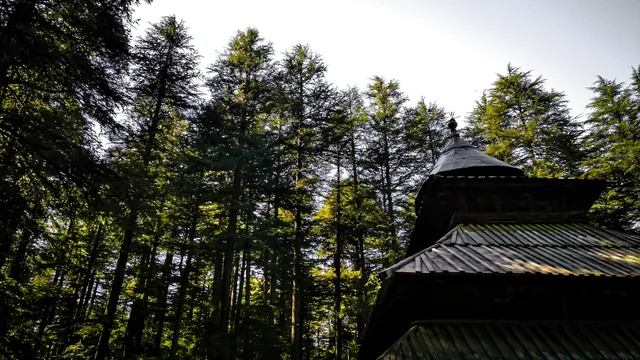
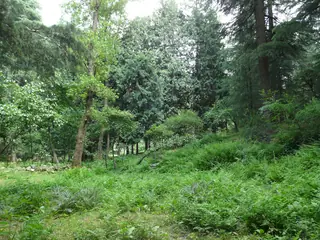
Hadimba Devi Temple — also written Hidimba Devi Temple, and called the Dhungri temple in Manali — stands in a grove of old deodars above the town. It is the temple of Hidimba, wife of Bhima in the Mahabharata and mother of Ghatotkacha, and she is the guardian goddess of this valley.
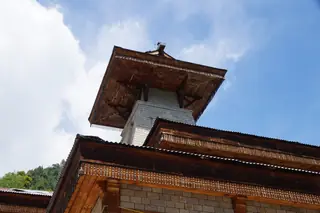
The sanctum is built over a huge rock that rises straight out of the ground, and the goddess resides in this rock. Inside, her footprints, carved into a block of stone, are worshipped, and her brass image is small enough to miss: about 7.5 cm (3 in) tall. The building around the rock is the other half of the wonder. On a stone base sit three square roofs of timber, one above the other, and on top a large metal umbrella with a metal finial forms the fourth. The whole tower is about 24 m high.
Watch our reel
Photos: Biswarup Ganguly (CC BY 3.0) · Biswarup Ganguly (CC BY 3.0) · Gerd Eichmann (CC BY-SA 4.0) · Kondephy (CC BY-SA 3.0) · Rishabh gaur (CC BY-SA 4.0) · Rahulsood146 (CC BY-SA 4.0) — via Wikimedia Commons, resized.
Its history
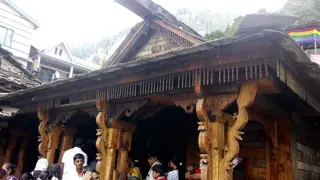
The board of the Archaeological Survey of India at the gate gives the date. An inscription on a wooden panel at the side of the entrance records that Raja Bahadur Singh had the temple raised, in a year that corresponds to AD 1553. The board also describes the carving around the door: deities, a devotee with folded hands, knots, scrolls and pot-and-foliage, with Ganesha at the centre of the lintel and a row of the nine planets above it. In 1967 the temple was declared a protected monument of national importance.
Look at the doorway before you join the queue: the carving rewards a slow look, and it is easier to see from outside than from the line.
Getting there
The temple is at Dhungri, above the western edge of Manali — a minute from the bus stand by road, or fifteen to twenty minutes on foot up through the town. Walk it: the lane climbs past old houses and the museum, and the top has no parking worth the name. From Old Manali it is a short walk across the Manalsu and up.
When to go
Before nine or in the last hour before dusk. Between ten and four the queue for the sanctum stretches down the lane and the stalls outside — yak photographs, angora rabbits, fur hats — take over. The festival in May, when the deity is carried and the valley comes, is worth seeing if you are here, and impossible to hurry.
Around it
Two minutes from the gate, the Museum of Himachal Culture and Folk Art has the house models, masks and tools that make the temple's timber-and-stone building easier to read. The path into the Manali Sanctuary starts nearby for an hour among the deodars. Old Manali is the walk on for lunch. Our stays and cafés pages show what is within ten minutes on foot.
Plans that include this
All 30 plans that stop here →


Nearby places
All of Manali →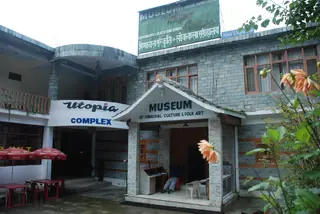


Nearby destinations
All destinations →
Questions people ask
What is the Hadimba Devi Temple famous for?
For the rock and the roofs. The sanctum stands over a great rock that rises out of the ground, and the goddess Hidimba resides in that rock. Above it climb three timber roofs and a metal crown, about 24 m in all, in an old deodar grove. An inscription by the door dates it to AD 1553.
Who built the Hadimba Devi Temple, and when?
The Archaeological Survey of India board at the gate says a wooden panel beside the entrance carries an inscription: Raja Bahadur Singh had the temple built, in a year that corresponds to AD 1553. The same board records that the temple was declared a protected monument of national importance in 1967.
What is inside the Hadimba temple?
The rock itself fills the inside, and that rock is the goddess. Devotees also worship her footprints, carved into a block of stone. Her brass image is tiny, only about 7.5 cm (3 in) tall. The sanctum is small and dim, and you go in a few people at a time.
When is the best time to visit Hadimba Temple?
Before nine in the morning or in the last hour before dusk, when the tour buses have gone and the grove is quiet. Between ten and four the queue for the sanctum is long and the lane outside is full of yak-photo stalls. The temple is open every day; the festival in May draws the whole valley.
How far is Hadimba Temple from the Manali bus stand?
About a minute by road and fifteen to twenty minutes on foot, uphill through the town towards Dhungri. Walking is the better way: the lane climbs past the old houses and the museum, and there is no parking to speak of at the top. A taxi will bring you to the gate if the climb is a problem.