Rampur Bushahr
town · 7.0 km away
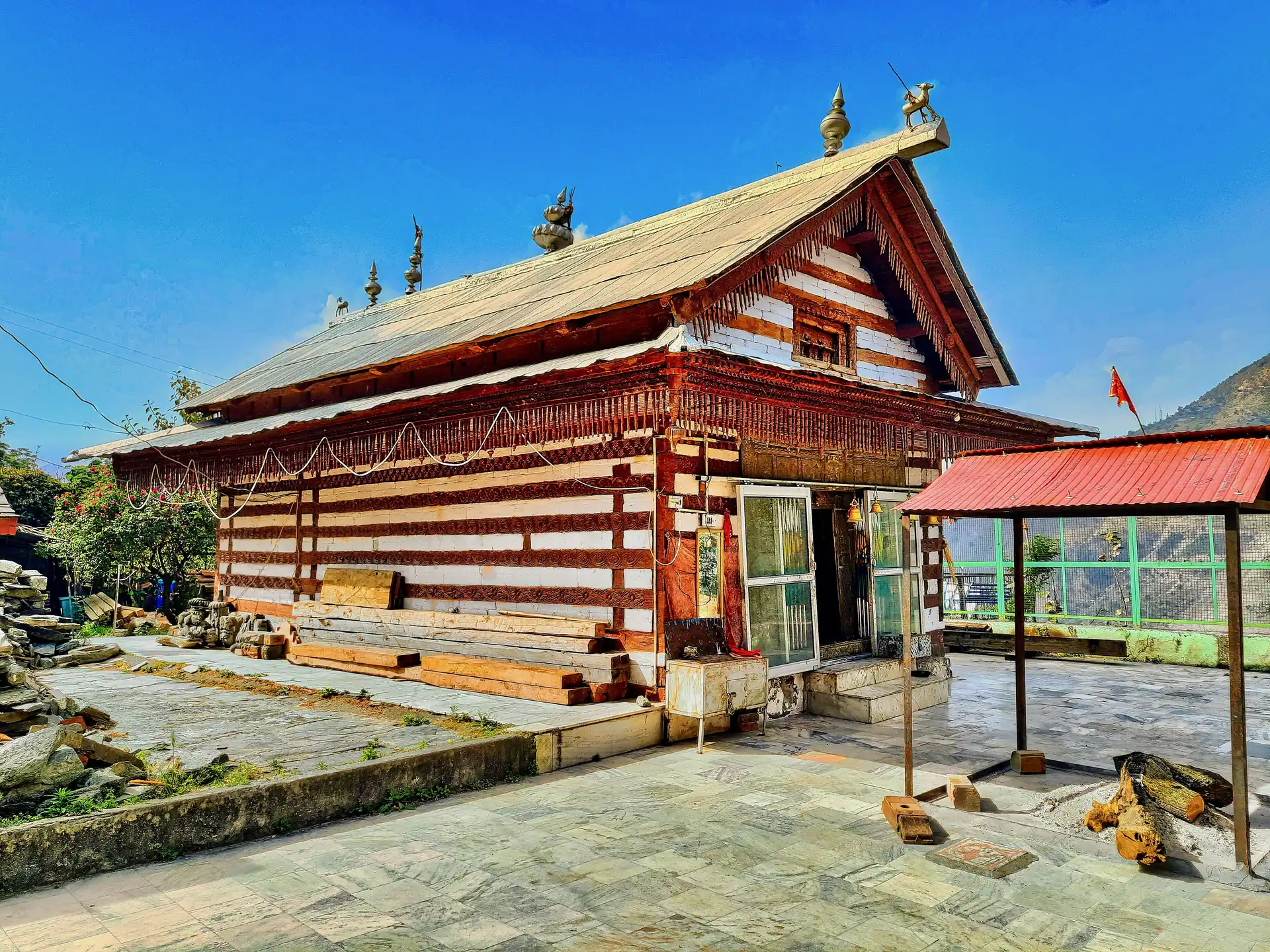
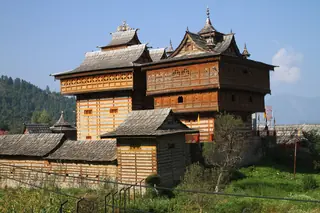
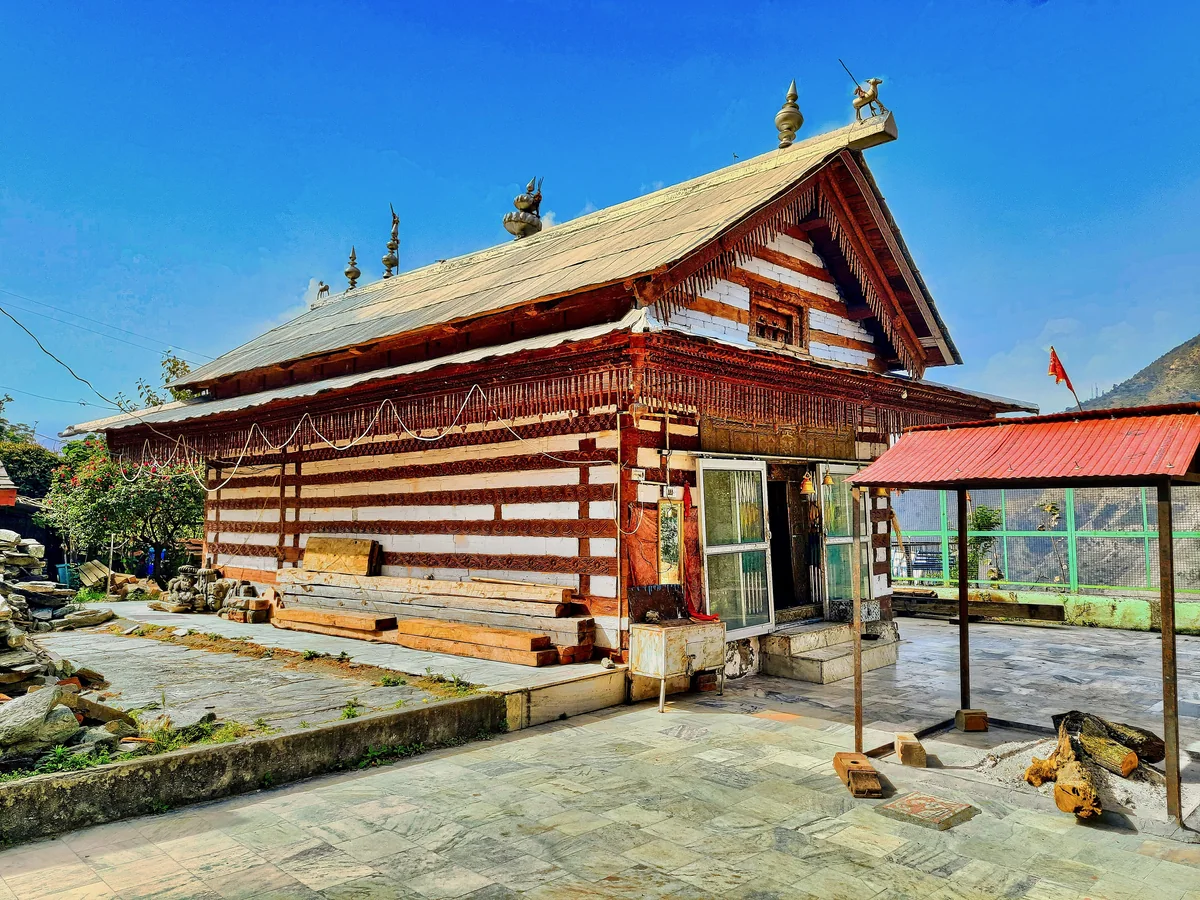
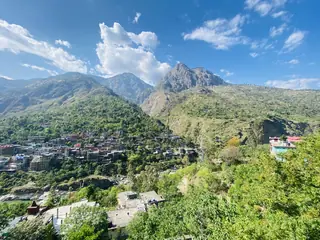
Nirmand is a large old village on terraces above the left bank of the Satluj, opposite Rampur Bushahr, in the Outer Seraj region. It is known for its cluster of medieval temples built of stone and deodar in the kath-kuni way, and local writing calls it the Kashi of the Himalayas for the number of its shrines. This page is named for the Ambika Devi temple, the village's main one, and covers the Parashurama temple and the Dakshineshwar Mahadev temple beside it.
Photos: Ms Sarah Welch (CC0) · Ms Sarah Welch (CC0) · Ms Sarah Welch (CC0) · Ms Sarah Welch (CC0) — via Wikimedia Commons, resized.
Nirmand is 17 km up the valley from Rampur Bushahr, and about 58 km and 115 minutes from Sarahan by road. That is too far for an add-on to the Sarahan day, so treat it as the second day of the two-day plan, with a night in Rampur or Nirmand. Homestays and a small public works department rest house give basic rooms in the village.
Start at the Ambika Devi temple, a largely wooden building with carved wall panels, door frames and brackets of deities and floral scrolls. Ambika, a form of Durga, is the goddess of the village. A copper-plate land grant of about the 7th century is kept in the temple. A ruler called Samudrasena issued it to endow learned Brahmins with land. A black stone image of the goddess, covered in gold leaf, is among its notable icons. Style dates the temple site to between the 6th and 8th centuries, though the buildings you see are younger.
The Parashurama temple, called locally the Parshu Ram Kothi or the Shankh temple, has a wooden superstructure on a stone plinth and carving to match. At its entrance stands a stone Vishnu dated on style to the 6th or 7th century. Local belief has Parashurama meditating in the area, and the village's own tradition says he founded it as a settlement of Brahmins. The Dakshineshwar Mahadev temple is a Shiva shrine visited through the year and busy at Maha Shivaratri. Among the smaller shrines is a stepwell, and the Deo Dhank cave, a rock shelter used by earlier ascetics, is a short way from the village.
Two festivals shape the village. Budhi Diwali, or old Diwali, is held about a lunar month after the main Diwali. Bhunda is a large ceremony held at long intervals, about every twelve years, in Nirmand and its neighbouring villages. Its central spectacle is a descent on a long rope of munji grass stretched across a ravine, and writers describe it as a survival of an older sacrifice that is now symbolic. Dates are not fixed, so ask in the village if you want to see either.
Any month the road is open. The terraces lie between 1,350 and 1,500 m, so the village sits far lower than Sarahan. See when to visit Sarahan.
Rampur Bushahr is the nearest town, 17 km back down the valley, and the Bhimakali Temple at Sarahan is the other half of the trip. The two-day plan puts them in order, and things to do in Sarahan has the rest.
A cluster of old wooden-and-stone temples above the Satluj, the largest village of its region, which local writing calls the Kashi of the Himalayas for its number of shrines. The main ones are the Ambika Devi temple, the Parashurama temple and the Dakshineshwar Mahadev temple.
The Ambika Devi site is dated on style to between the 6th and 8th centuries, and a copper-plate land grant of about the 7th century is kept in the temple. Carved wood and stone across Nirmand has been dated from about the 7th to the 14th century. The present buildings are younger than the site.
Nirmand is about 17 km up the valley from Rampur Bushahr, and about 58 km and 115 minutes by road from Sarahan on our routing. That makes it a second day rather than a stop, so most visitors spend a night in Rampur or Nirmand.