Darjeeling Himalayan Railway — the toy train and its loops
Checked on
What it is
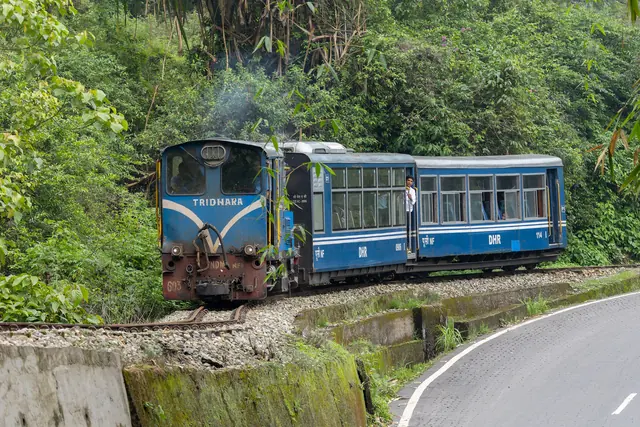
The Darjeeling Himalayan Railway, the DHR or "toy train", is a narrow-gauge line between New Jalpaiguri and Darjeeling. Wikipedia describes a gauge of 610 mm and a length of about 88 km, built between 1879 and 1881, and says it was declared a UNESCO World Heritage Site on 5 December 1999.
The climb
The line gains height from about 100 m at New Jalpaiguri up to about 2,200 m at Darjeeling by using six zig zags and three loops, where the train reverses or circles over its own track. Wikipedia says the route follows the Hill Cart Road, so the rails run beside the road for long stretches and cross it at places, with the engines sounding loud horns to warn pedestrians. The Batasia Loop, of 1919, is the best-known spiral, and Ghum is India's highest railway station.
Why it runs backwards
The first line simply followed the Hill Cart Road, and in places the road was steeper than the engines could manage. So in 1882 the builders added four loops and four zig-zags between Sukna and Gayabari, which eased the climb to an even gradient of 1 in 28. Today the line has six zig-zags, called reverses, and three loops; there were once five loops.
A zig-zag lets a train climb a hillside too steep to go straight up. It works in three moves:
- Forwards into the zig-zag, until the train runs into a dead end and stops.
- Backwards up the middle leg, with the engine now pushing from below.
- Forwards again, higher up the hill, and on towards Darjeeling.
The three photographs in the strip below were taken one after another in 1993, on one zig-zag, and show exactly those moves.
Photos: MaltaGC (Nigel Tout) (CC BY-SA 4.0) · MaltaGC (Nigel Tout) (CC BY-SA 4.0) · MaltaGC (Nigel Tout) (CC BY-SA 4.0) · Syed Sajidul Islam (CC BY-SA 4.0) — via Wikimedia Commons, resized.
Each time the train goes forwards, reverses and goes forwards again, it has climbed a step up the side of the hill. Gayabari has the last reverse on the way up. At Kurseong the station itself is a dead end, so trains bound for Darjeeling back out of it, across a busy road junction, to carry on climbing. Higher still, the line's loops do the same job by turning in a circle over their own track: the Batasia Loop below Ghum was built in 1919, and Loop 4, known as Agony Point, has the tightest curve on the line.
Riding it
Wikipedia says tourist trains run daily between Darjeeling and Ghum and a steam-powered service named Red Panda on to Kurseong, with extra steam trips for enthusiasts, and that diesel locomotives handle most scheduled services. We have no verified timetable, fares or booking rule, so ask at the station. Wikipedia gives speeds of 20 to 25 km an hour, so think of it as a slow ride, not a transfer.
Getting there
Darjeeling station is in the town centre; see the quick facts for our measured road time. For the monastery at Ghum and the loop see the Yiga Choeling Monastery.
Combine it with
The two-day plan uses the train for the second morning, and the one-day plan passes the loop by road. For three days around the line, see Darjeeling in three days: Tiger Hill, tea and the zoo and the tea gardens guide. Read things to do in Darjeeling and how to reach Darjeeling.
Watch our reel
Going to Darjeeling?
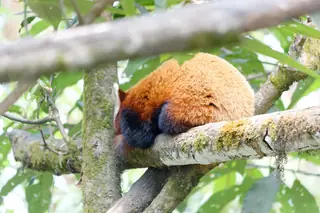 Darjeeling with kids in two days — red pandas, a toy train and a tea garden1 night · 2 days, ready to copy and change
- Stays in DarjeelingCompare live prices
- See it on the map
- Send this on WhatsApp
Reels from these places: follow @himlocal.in on Instagram
Run a café, a stay or a trek company near Darjeeling Himalayan Railway? List it on HimLocal →
Plans that include this
All 2 plans that stop here →

Nearby places
All of Darjeeling →


Nearby destinations
All destinations →
Questions people ask
What is the Darjeeling Himalayan Railway?
A narrow-gauge line of 610 mm, about 88 km long, between New Jalpaiguri and Darjeeling, built between 1879 and 1881 and known as the toy train. Wikipedia says UNESCO declared it a World Heritage Site on 5 December 1999. It rises from near the plains, about 100 m above sea level, up to about 2,200 m at Darjeeling.
Can you ride the toy train in Darjeeling?
Wikipedia says tourist trains run daily between Darjeeling and Ghum, the highest railway station in the country, and that a steam-powered service named Red Panda goes on to Kurseong, with extra steam trips for enthusiasts. We have no verified timetable, fares or booking route, so ask at Darjeeling station for what runs on your day.
How fast does the Darjeeling toy train go?
Slowly. Wikipedia says that the trains move at between 20 and 25 km an hour, and that the line follows the Hill Cart Road, so its rails look like tram tracks through the town. Because of the steep terrain it uses six zig zags and three loops to gain height, including the Batasia Loop of 1919.